Two Trucks Hit on the I-95 Shoulder in One Night — The Parking Shortage Is Killing People
Parking Horror Stories — real incidents, real lessons.
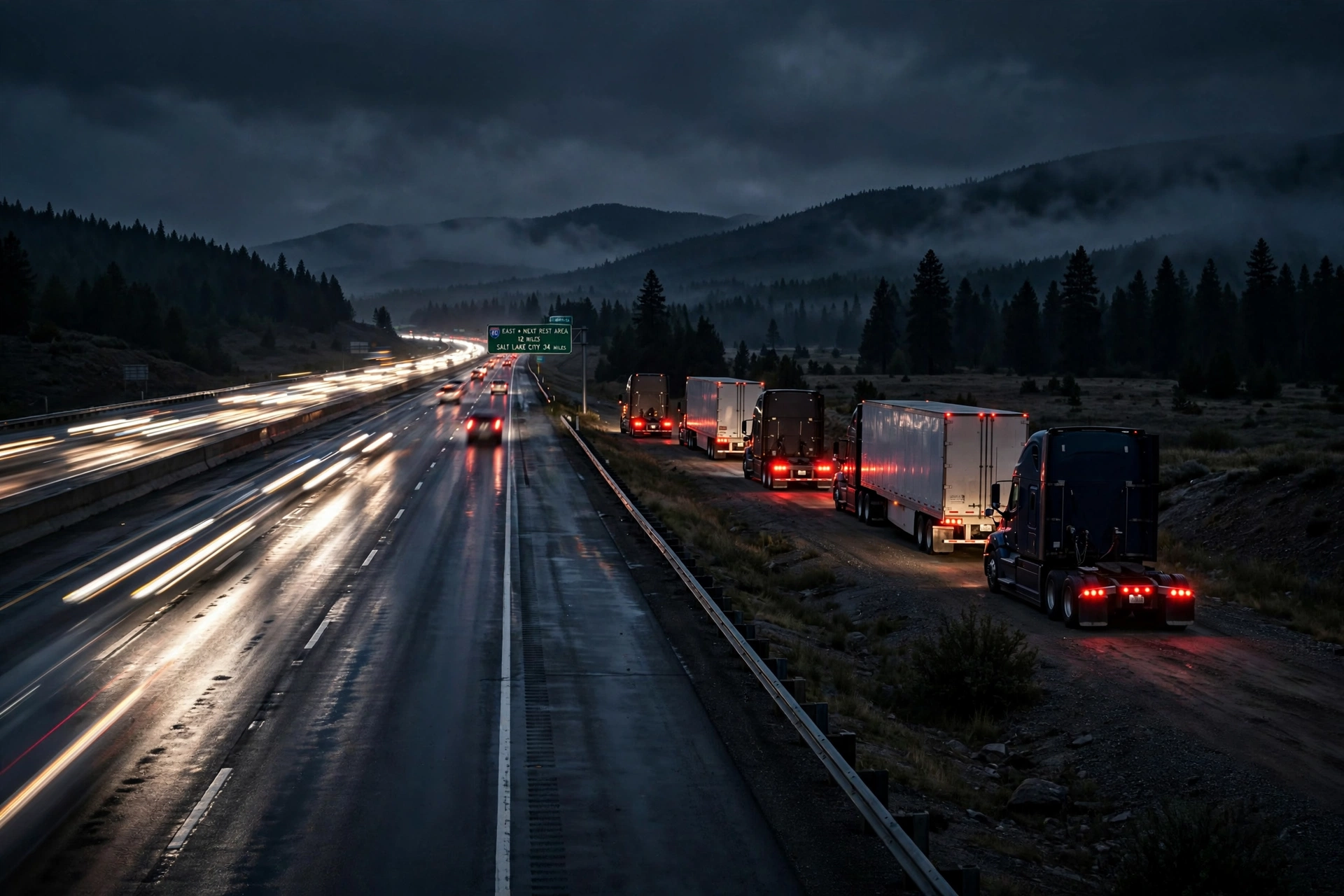
On the night of October 4, a driver pulled her tractor-trailer onto the right shoulder of I-95 in McIntosh County, Georgia, just for a restroom break. She was climbing back into the cab when another truck slammed into the back of her rig at mile marker 47. The impact flipped the moving truck onto its side. Her truck was hauling isopropyl alcohol. Diesel spilled across the highway. She was injured and taken to the hospital in Brunswick. I-95 southbound shut down until 8:15 the next morning.
Seven hours later, while a trooper was still dealing with that mess, a sedan drifted onto the shoulder at mile marker 52 and hit the back of another parked tractor-trailer. The car’s driver was killed on the spot.
Two crashes. Same stretch of highway. Same cause: trucks parked on the shoulder because there was nowhere else to go.
This Isn’t Bad Luck. It’s Math.
There is roughly one safe truck parking space for every 11 trucks on the road, according to OOIDA. Drivers burn an average of 56 minutes a day hunting for legal parking — that’s about $7,200 a year in lost pay, per ATRI research. And I-95 through Georgia is the most congested freight corridor in the country with almost no legal parking after 8 or 9 p.m.
A driver who runs that stretch regularly put it plainly: after dark, there’s nowhere to stop, and “when you stop, you almost die. Mentally, you know?”
He’s right. And here’s the part nobody wants to say out loud: we keep making the same gamble. Running the clock to zero hoping a spot opens up. Pulling onto a shoulder or a ramp “just for a minute.” Every driver reading this has done it. I’ve done it. But shoulders are where people die — the woman in Georgia was parked for a bathroom break and nearly lost her life, and a sedan driver who had nothing to do with trucking lost his.
Drivers: Plan the Stop Before the Clock Runs Out
Nobody’s coming to save us on this one, so the first move is ours. That means:
- Decide where you’re stopping before you start driving. Not at hour 9 of your 11. Before you roll.
- Reserve the spot. We reserve hotels, we reserve loads — a $15–30 reserved parking spot is the cheapest insurance in trucking.
- Stop early rather than late. The spot you skip at 6 p.m. won’t be there at 10 p.m.
Companies: This Is Your Problem Too
Now the part for the carriers and dispatchers. You plan our fuel stops, our routes, our appointment times — but parking is somehow “the driver’s problem”? A driver out of hours with nowhere legal to park is a company liability rolling down the interstate at 65 mph looking for a shoulder.
If you’re running trucks, reserved parking should be built into trip planning the same way fuel is. Pay for the spot. It’s $15–30 a night against a wrecked tractor, a hazmat spill, a closed interstate, and a dead motorist. The math isn’t hard.
The industry is already moving this way — 93 of the top 100 U.S. fleets now use Truck Parking Club for their drivers. Parking is becoming a driver perk, like decent home time. Fleets that figure this out will keep drivers. Fleets that don’t will keep reading stories like this one.
The Tool That Exists Right Now
Truck Parking Club has 7,000+ reservable locations across all 50 states — warehouses, terminals, repair shops, private lots — bookable from the app before you ever turn the key. No more rolling the dice on a full truck stop at 1 a.m.
If you haven’t tried it, use my code trucknthings for $20 off your booking. (That’s my affiliate code — it supports what I do here, and it saves you real money. Win-win.)
The Bottom Line
Two crashes in seven hours on the same Georgia highway. One dead, one injured, both directions of I-95 shut down. A woman parked for a bathroom break. A sedan driver who never saw it coming.
The parking shortage didn’t cause these crashes the way a blown tire causes a crash. It caused them the way a loaded gun causes a shooting — it put everyone in a position where the slightest mistake turns fatal.
Plan your stop. Reserve the spot. And companies — stop treating parking like it’s not your bill to pay.
Sources: Incident details via American Truck Drivers / local Georgia media reporting (Oct 2026); ATRI parking research; OOIDA statements. TPC location count per Truck Parking Club, October 2026.
Leave a Reply